
Reverse Ears are autonomous listening objects, suspended between instrument and organism. They blur the line between hearing and being heard, presenting listening as a shared, reciprocal act that extends beyond the human.
Reverse Ears began as an attempt to retrain my listening—away from analysis and language, toward the body. I had long treated sound as information to decode and arrange. Then came a shift: listening is a biological transformation in which external stimuli become subjective—private, innate, primal. Like touch, it reaches the body before the mind can name it.
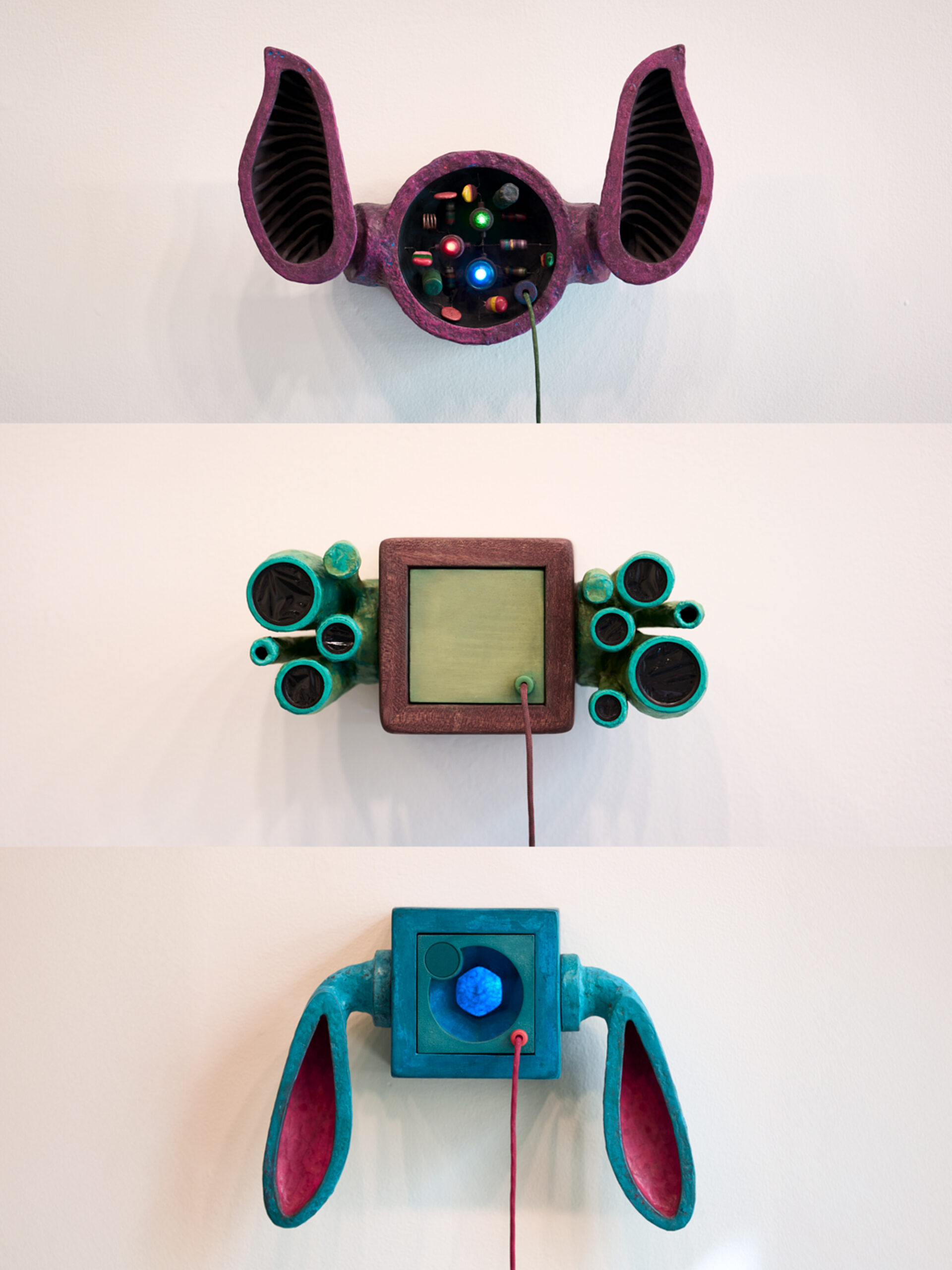
Reverse Ears: Bat, Frog, Hare, 2025, wood, metal, cloth, PLA, acrylic, paper, resin, epoxy clay, electronics, sound.
Conceptually and technically, Reverse Ears reimagines the conventional stereo player as an embodied presence rather than a neutral media vessel. The system is inverted: ears are externalized and materialized, and hardware is treated as anatomy. In conventional electronic theory, ears function as inputs—receptors that convert vibrations into signals. Here, that logic is reversed. Speakers embedded behind the ear horns transform the receiver into an emitter, reconverting the electrical signal into vibration so the chamber itself resonates as a sounding body. The stereo thus shifts from passive conduit to active organism, processing and projecting its internal states into space. I approach each work as both composer and architect, establishing formal and behavioral rules that structure the system while allowing responsive variation.
The project employs biological sensation, duration, and exchanges between body, object, and environment. Surface texture operates as skin and temporal record: chemical reactions, abrasions, and accumulated marks register gesture and extended time, rendering transformation perceptible.
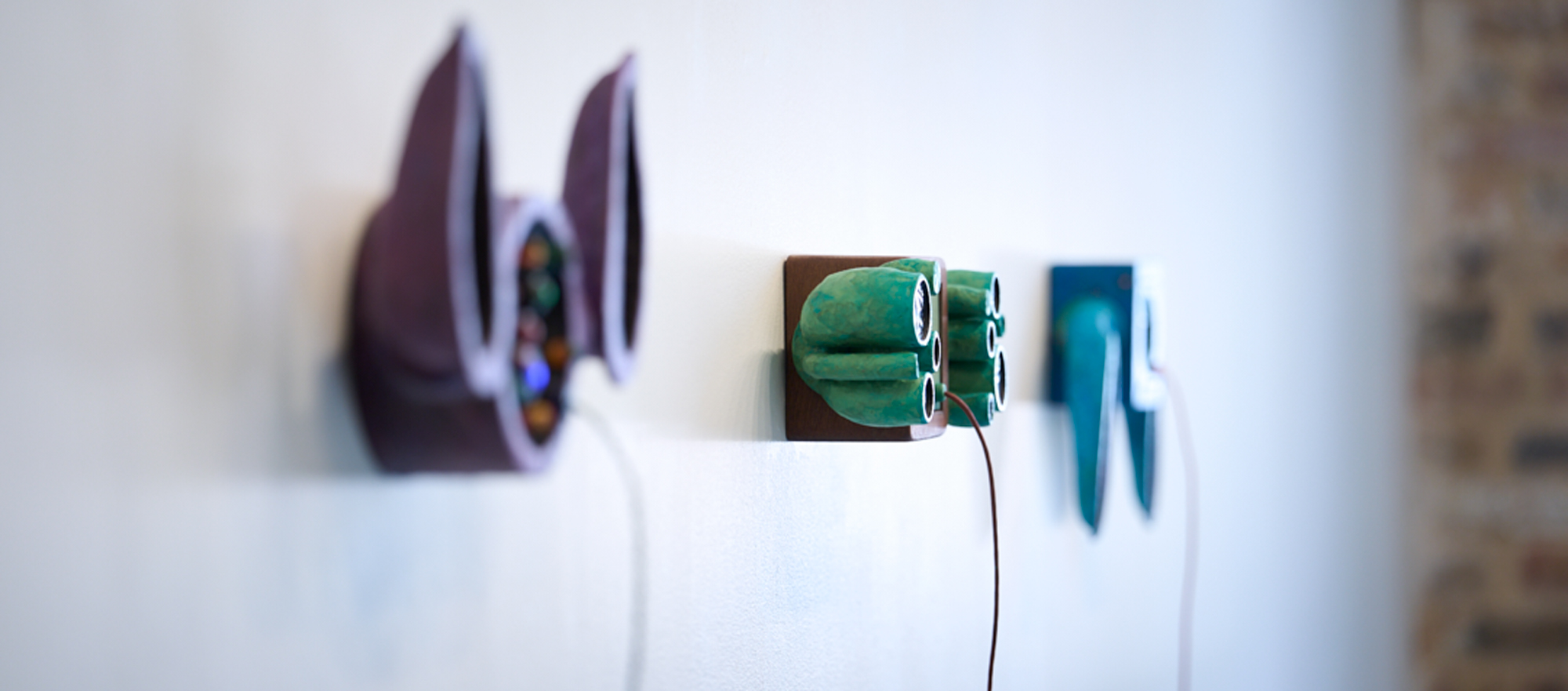
The sculptures integrate sensors, custom code, and probabilistic structures to produce evolving soundscapes in real time. Their sound systems draw on research into the perceptual capacities of the bat, frog, and hare, combined with embodied speculations on their sensory pathologies. I render the figures visually and sonically, composing their reactive behaviors through drones, rhythms, and patterns. The frog uses multiple kazoo membranes tuned differently in each ear to “stereofy” an embedded subwoofer; the bat recirculates modulated echoes from the gallery; the hare responds to proximity, mapping movement in zones before the viewer. Embedded lighting tracks probabilistic shifts, exposing the system’s internal logic. The series remains open-ended, positioning Reverse Ears as both an ongoing body of work and a formal sculptural type.